With every new generation of GPS receivers it seems like battery life takes a hit as the displays get bigger and CPUs get faster. The Oregon and Colorado haven’t been immune to this decline in battery life and many owners have complained about how frequently they have to replace batteries. By running some controlled tests I’ve been able to compare battery life on these three handheld GPS units and provide some tips on how to extend your battery life.
First, I only used NiMH batteries in my tests. Garmin recommends 2500mAh NiMH batteries or higher for use in the Colorado and Oregon and for most people this will be the natural choice given the expense of using Lithium or Alkaline batteries in these power hungry devices. I used PowerEx 2700mAh NiMH batteries and a Maha MH-C9000 charger to guarantee that I was using properly charged and conditioned batteries. The Maha charger was also useful for measuring battery charge and discharge during each test.
The only variable I changed during my testing was the GPS backlight setting - I tested with backlight at 100%, 50% and off. The rest of the test conditions and settings on the GPSs were as follows:
- WAAS disabled
- Compass disabled
- Automatic backlight shutoff disabled
- SD data card installed
- Tests conducted with the satellite page displayed
- Tracklog set to auto or collect every 30 seconds
- Satellite reception for duration of test although units were stationary
- Temperature was maintained around 20C (68F-70F).
- 60CSx: Power saver mode disabled
- Colorado: Backlight limiting disabled (i.e. backlight stays on until the unit shuts off)
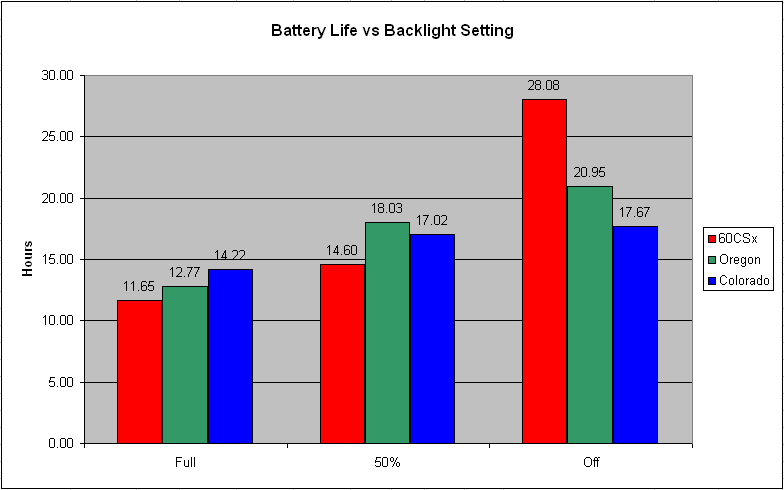
The test simply involved loading each GPS with freshly charged batteries and letting it sit with a view of the sky until it shut off. Using the tracklog I determined how long the unit ran before shutting down. The graph below depicts battery life for the three units for each backlight setting.
In an attempt to normalize the results I also used the charge delivered to the batteries minus the remaining charge after the test to calculate how much power each unit consumed and converted that to an average current draw. The second graph displays the current drawn by each unit so that if you are using different capacity batteries you can determine your run time by dividing battery capacity (mAh) by this value.
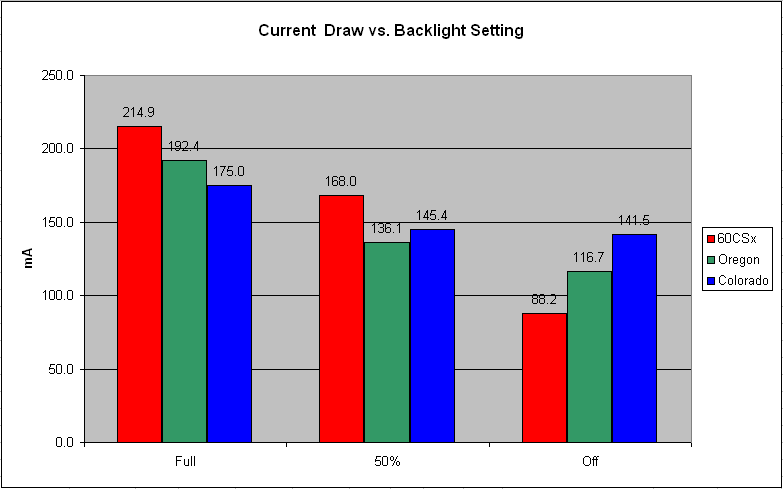
The results of the tests were different than I had expected. I had assumed that the 60CSx would be far better than the Oregon which, in turn, would be marginally better than the Colorado. This turned out to be true for cases where the backlight was turned off, the 60CSx came in with 28 hour run times compared to 21 hours and 17.5 hours on the Oregon and Colorado respectively. Keep in mind the 60CSx is actually readable with the backlight turned off, I don’t think I’ve ever used my Colorado or Oregon with the backlight entirely off.
Surprisingly with the backlight turned up to 100% the 60CSx was worse than both the Oregon and Colorado. The 60CSx managed only about 11.5 hours of run time whereas the Oregon was close to 13 hours and the Colorado was over 14 hours. The fact that the Oregon didn’t run as long can be attributed to the backlight being somewhat brighter than the Colorado’s under the max setting. The bad news for Oregon and Colorado owners is that this will probably be more typical of your battery life. If you are willing to use the automatic backlight shutoff feature you will see somewhat better results.
At the 50% backlight setting the Oregon did a little better than both the 60CSx and Colorado but the results are similar for all three units.
How well does this translate into field use? The biggest factor that this test does not take into account is how movement and interacting with the device affects battery life. If you are calculating routes and navigating while viewing the map or 3D-view pages there is going to be more load on the CPU. Some old measurements on the Colorado suggest this might reduce battery life as much as 20%.
Other factors to consider:
- NiMH batteries are particularly poor in below freezing temperatures.
- If you can’t avoid cold temperatures look to Lithium batteries which provide better run time, better performance in temperatures below freezing and weigh about 30% less.
- Avoid lower capacity (less than 2100mAh), worn out or improperly charged NiMH batteries. Invest in a good charger like the Maha MH-C9000 or La Crosse Technology BC-900 AlphaPower.
- Use of compass or WAAS reduces run time by about 20% and 5% respectively (based on Colorado)
- Use of the automatic backlight shutoff feature or reducing your backlight usage will improve battery life, although on the Oregon and Colorado you’ll probably find that you need the backlight set at 50% or more.
- If you use your GPS in the car invest in an automotive kit which will power the unit using your car’s power adapter saving the battery during those long rides.
As long as you are willing to invest in decent NiMH batteries and a good charger all three models will provide nearly 12 hours of continuous operation on a single set of batteries no matter which backlight settings you choose. Throwing in an extra set will cover you for the weekend. Backcountry hikers might want to consider the 60CSx given the extra 8-10 hours of run time at low backlight settings.
Versions: Colorado 2.7/GPS 2.8; Oregon 2.6/GPS 2.55; GPSMAP 60CSx 3.6