Background
I put together this page after finding GPSfix's tests on the battery life of the Oregon and others very useful, but I wanted a bit more detail on choosing the backlight/battery saving option for my Oregon. So I did some direct measurements of current for each of the backlight options, and projected these to battery lives comparable to the GPSfix data points. The absolute predictions will depend on battery, but it should give a good idea of the relative battery life with each backlight option.
I did the testing for my own benefit, but thought it was worth writing up in case anyone else finds it useful.
Settings
I've tested my Oregon 200 with no WAAS, set on the map page at 300m scale, no compass or barometer (200 doesn't have them), SD card inserted. I used the map page because that's how I normally use the device, so that was what I was interested in.
I also verified that using the backlight timeout gives a current consumption equal to steady backlight on 0%. Just because I'm paranoid.
Projected Results
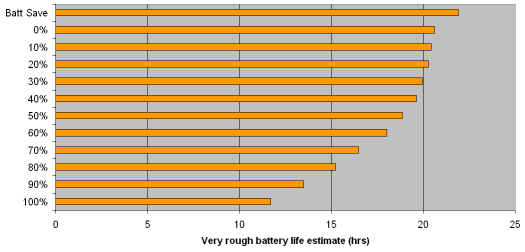
Firstly you can see that the backlight levels ramp up non-linearly as you would sensibly expect. This means that as Garmin says, if you leave the backlight on at something above 50% all the time, you'll pay for it.
But even at 100% light, it's only down to half as much life. That means if you're using a backlight timeout anyway and you don't think it's on for more than a fraction of the time, then it'll actually make very little difference to your overall runtime. i.e. if your backlight is only on for less than 10% of the total time anyway, using full backlight will make <10% difference to your runtime. So if you're using a backlight timeout the majority of the time, feel free to use plenty of backlight, it won't make a lot of difference.
At the other end of the scale, for use at night: If you're willing to use the battery save mode, and thus turn off the display at night, you can gain another hour or so over having it on all the time without backlight. However, you might also care to notice that if you only use 20% or so backlight, you consume a negligible amount more than if you have the display on with zero backlight. If you're using it at night, out of town in a dark area, you can leave it on all the time at 20% backlight and not suffer very much loss of runtime at all. (this was what I wanted to know, for using on a bike at night)
Lastly, I want to repeat that the results are best used as relative figures to choose your mode. The absolute scale in hours is calibrated indirectly, as described below. It is at best a rough indication.
Method
I powered the Oregon with a bench power supply, and measured the current being supplied. This has a steady background level, but spikes up once every second or so. I couldn't be bothered to set up a longer term averaging to record this, so captured the steady background current in each mode instead. It's much easier to get a repeatable accurate measurement that way. These raw measurements are below.
| Backlight setting |
Steady current (mA) |
| 100% |
175 |
| 90% |
147 |
| 80% |
126 |
| 70% |
114 |
| 60% |
101 |
| 50% |
95 |
| 40% |
90 |
| 30% |
88 |
| 20% |
86 |
| 10% |
85 |
| 0% |
84 |
| Battery save |
77 |
I could see that it was spiking up by several 10s of mA, but it's not particularly easy to get a measurement of the charge under that extra curve. However, I expected it to be a fixed amount regardless of backlight mode, so instead I took my results and compared them to GPSfix's average consumption figures measured over a whole battery life. I found these fitted, very roughly, about 35mA higher than my measurements. Since this matches up pretty well with a chunk of extra current for the spike, I decided to run with it.
So I added this 35mA to each of my currents, and created projected battery lifetimes comparable to the GPSfix figures by working back to his ~2500mAh capacity from the two graphs combined. These are what's plotted above.
This method isn't perfect, but should give a pretty good idea of how the lifetime will vary as each of the modes are used. The absolute value of the lifetime will obviously vary depending on the battery, temperature, and usage. Maybe even the density of map data, who knows?
